We arrived in Peoria, Illinois on July 24, 2014 and decided
to stay for 3 nights in order to see the town and to catch up. The Mill Creek Campground—a remarkably
inexpensive Passport America park-- in East Peoria is located right on the
banks of the wide Illinois River, a major tributary of the Mississippi River,
which begins near Joliet, Illinois and 273 miles later, near Grafton, IL, south
of St. Louis, the Illinois River joins the Mississippi River, only 20 miles
upstream from where the Missouri and Mississippi Rivers join.

Two river channels loop around the Mill Creek Campground
areas closest to the Illinois River. The
ground was quite muddy after rain but we walked out to the river's edge. We watched a huge tug and extremely long
barge combination heading down to Peoria or beyond moving very slowly downriver
at about 3-4 knots with the river current.
A short time later we watched a smaller tug pushing a construction barge
with a large crane also heading downriver.
There were small footprints like raccoon prints in the mud but we never
saw any animals or turtles. We did see
many thousands of minnows swimming in convoy and occasionally something under
them taking a gulp of them, probably a bigger fish!


 One major reason to visit Peoria is the headquarters of Caterpillar
Inc., the world's largest producer of earthmoving equipment, railway locomotives and a major
manufacturer of electric power generators and engines used in petroleum markets
and mining equipment.
One major reason to visit Peoria is the headquarters of Caterpillar
Inc., the world's largest producer of earthmoving equipment, railway locomotives and a major
manufacturer of electric power generators and engines used in petroleum markets
and mining equipment. 
The Caterpillar Visitors Center is a large modern
building located in the heart of downtown Peoria on the Riverfront at 110 SW
Washington St. and is open Monday-Saturday10AM-5PM. We went on Saturday, July
26. There is a $6-7 admission
charge. Your self-guided tour begins
with an orientation film shown inside a two story tall, 400 ton CAT 797F massive
mining truck converted into a 62 seat “rumble-seat” theatre—meaning the whole
theatre vibrates as the massive machines move across the screen--pretty
exciting in itself!

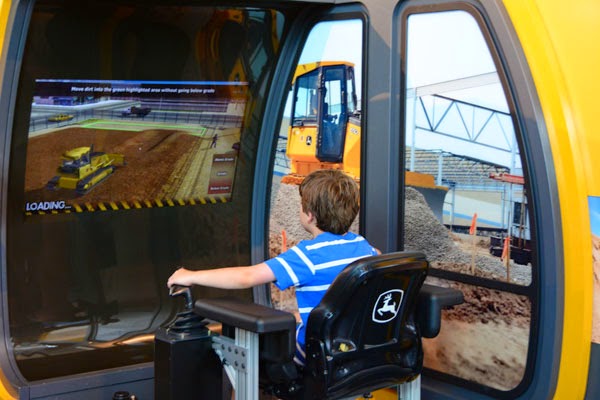
A highlight for visiting kids, beyond the huge machines, is a
group of simulators of different pieces of large construction equipment, allowing you to sit in the
cab and operate the controls, like a real operator! Lin was doing well in his bulldozer simulator
until he hit a large tree--Whoops!

The Heritage Gallery shows some of the first Caterpillar
machines from the 1920s-30s including one of the first bulldozers.
Another area shows production of various CAT construction machines but
the highlight for us was a time lapse video of the construction of the giant
797F mining truck (like the truck that is the introductory theatre.) This vehicle is so large, all the components
must be shipped to the jobsite, usually a large mine, and the truck built on
site—an amazing logistics and labor exercise!

The “CAT at Work around the World” Gallery is very
interesting too. Since its founding in
1925, Caterpillar equipment has worked on virtually every major project, not
only in North America, but the entire world!
CAT products helped build San Francisco's cable car system, the Golden
Gate and Bay Bridges, most major dams in the U.S. and beyond, the Alaska
Highway in 1942 and much more. Today, CAT machines are widening the Panama
Canal and worked on the construction of China's massive Three Gorges Dam.

In World War II, Caterpillar worked 7 days a week, doubled
their workforce, added women working in the foundry and machine assembly lines
and built 51,000 armored versions of track-type tractors painted Army olive
drab and trained Army enlisted men to operate them! CAT diesel engines and transmissions powered
Sherman tanks plus they manufactured howitzer carriages, artillery shells, bomb
fuses and much more. Strangely, Caterpillar
did not show their war production in the history display.
Today, Caterpillar has 118,501 employees around the
world! They manufacture, and sell
globally, heavy equipment including a very wide range of construction and
mining equipment, forestry machines, EMD railroad locomotives, industrial gas
turbines, diesel and natural gas engines and all types of power
generation. CAT also has an important
Financial Products division supporting their dealer network and customers.
Another important division is Parts and Customer Service that keeps machines
running worldwide! 69 % of CAT's sales
and revenues come from outside the U.S., with 31% in the U.S!
 |
| You can even design your own CAT!! |
You can take home some CAT too with the CAT Merchandise
Center onsite to entice you with CAT toy bulldozers and other machines, T-shirts, boots and much
more! Caterpillar is a very impressive
company and this Visitor Center gives you a complete look at the workings of
the whole company!


After our CAT tour, we walked a
block to the Farmer's Market held in the large Riverfront Park right on the river. Lots of
craft items plus fresh produce, bakery goods, honey etc. Live music was good and the whole scene had a good vibe.Train tracks run parallel to the market and
we were blocked in by a mile long coal train for a few moments. No problem--we
like trains!


The next day July 27, we drove east to Moline, IL on the
Mississippi River to visit the John
Deere Co., founded in 1837, one of the oldest industrial companies in the
United States. It began when John Deere,
a blacksmith, produced a radical new self-cleaning plow that changed
agriculture!

”If you measure fun and excitement by the pound, you'll
find tons of both at the John Deere Pavillion.
Our all-new visitor experience features literally tons of big, powerful
machines. Some are staged in their
typical work environments, so you can climb aboard to see and feel what it's
like to run these machines.
You'll hear real customers as they share their workdays
with you. And you'll want to test your
skills in real life job situations by grabbing the controls of our simulators.
There's also lots of history to explore, innovations to
discover, prototype machines to inspect, and global challenges to learn
about. Parents, please note that your
youngsters may have so much fun in our Discovery Zone that they won't want to
leave.
It's fun, exciting and educational. And admission is always free!” *

 |
| A mural of the first factory, the original Deere plow and the old and new logo |
We discovered many new things about this legendary
manufacturer and really enjoyed seeing so many of Deere's machines up
close. John Deere is the world's biggest
producer of farm equipment like farm tractors and combines and also a large
maker of construction machinery as well as commercial and home lawn and garden
equipment. John Deere has 67,044 employees
globally. U.S. sales are predominant at Deere with only 36% of sales outside the
U.S. We were impressed with the John
Deere core values set forth by John Deere, the founder: Integrity, Quality,
Commitment and Innovation. They see two
major challenges facing the world in coming decades: “Feeding a population
growing in size and affluence” and “Developing the infrastructure
required to support massive urbanization.”

Deere operates with 3 divisions: Agricultural and Turf producing
77% of revenue and 16.1% of operating profit; Construction and Forest
Products produc ing 16% of revenue and 6.4% of profit; and Financial
Services producing 7% of revenue but 31.1% of profit!

Agricultural products include tractors, loaders, combines,
cotton and sugar cane harvesters, tillage, seeding and soil prep machinery and
hay and forage equipment for the global farming industry. Turf is commercial and home small lawn tractors, lawn mowers, golf
course equipment, utility vehicles, and landscape and nursery products. Construction & Forestry includes
construction, earthmoving, material handling, timber harvesting, backhoe
loaders, crawler dozers, 4WD loaders, excavators, motor graders, articulated
dump trucks, landscape loaders, skid steer loaders, log skidders, feller
bunchers, harvesters and attachments. Financial Services finances sales and
leases by JD dealers of new and used equipment to all industries, wholesale
financing to dealers and retail revolving charge accounts. We were interested to learn that customers
can buy crop insurance from John Deere as well!


John Deere is obviously proud of their World War II
production record and feature it in their introductory history panels. Deere produced MG 1
& 2 heavy tractors for moving aircraft, M3 tank transmissions, the Deere
Wagon Works produced large mobile laundry units and the Harvester Works
produced airplane parts and more. Many
women were hired to replace men called up into the military and these women
played an important role in production.

John Deere was an early progressive
company in many ways. In 1880s they
started an 8 hour workday from 10 hour days formerly; 1881 added electric
lights to the factories; 1887 paid employee health and accident benefits; 1907
established pensions; and in 1909, the company built employee housing when
there was a housing shortage.

 Yes, John Deere competes with Caterpillar and others in the
construction and forestry markets and as we traveled the Interstates after
Illinois, we checked the many road construction projects underway and saw a
higher percentage of CAT equipment but lots of John Deere in use as well.
Yes, John Deere competes with Caterpillar and others in the
construction and forestry markets and as we traveled the Interstates after
Illinois, we checked the many road construction projects underway and saw a
higher percentage of CAT equipment but lots of John Deere in use as well.
Deere & Co. operates a number of attractions all in or
near Moline and most have free admission.
John Deere's World Headquarters in Moline at One John
Deere Place is open 7 days a week. “See
John Deere products new and old, as well as a display of 2200 items related to
the company's history, inside this architectural masterpiece.” * John Deere's headquarters were designed by
famed Finnish architect, Eero Saarinen.
We ran out of time and didn't visit here. “Next Trip!”
John Deere Historic Site is in Grand Detour, now
Dixon, IL and “gives you a first-hand look at the blacksmithing trade in this
replica of John Deere's shop” next to the foundations of his original
shop. You also tour the inside of the house
he built for his family with period furnishings.* (Fee includes both shop and
home)

You can also visit the John Deere Harvester Works in
East Moline on weekdays when it is operating. This factory has produced John
Deere combines for 100 years, “helping farmers meet the challenges of feeding
an expanding global population with innovative and efficient machines.” * This
is free, but a reservation is needed. It
was not open on Sunday when we were in Moline.
Finally the Deere-Winan House, built in 1872, and the Butterworth
Center, built in 1892, are “the magnificent mansions and gardens that the
Deere family once called home.” * Open
Sundays by appointment with donations appreciated.

To wrap up, somehow we felt more comfortable at the John
Deere Pavilion than at Caterpillar's Visitor Center, since the CAT site seemed
to be a very elaborate sales tool to take their customers through while the
John Deere Pavillion felt like it was
primarily set up for the general public including the all-important farm
families.
 |
| A Toy store for big and small boys! |
Incidentally, the John Deere Store is adjacent to the
Pavillion and is loaded with lots and lots of green John Deere merchandise from
ball caps, clothing of all types, great toys including tractors, books, videos
and much more. Our grandkids will be
disappointed to hear that we didn't get them anything—sorry, no room in the
RV!
* from John Deere Attractions “Where the Legend Lives On”
brochure.

 |
| Taken from the video-- a good example of Deere's agricultural might! |