Thursday, March 12, 2015

DeGrazia Gallery in the Sun, Tucson


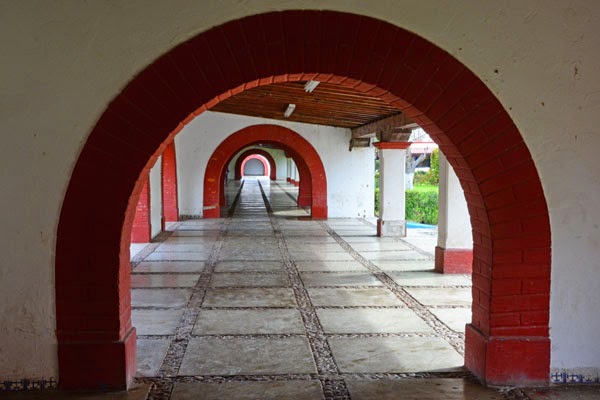
As soon as you get out of your vehicle in the DeGrazia Gallery in the Sun parking lot, you'll see that this is no ordinary artist's gallery!    Rather it's a composite of the desert landscapes of Southern Arizona and Sonora including an impressive adobe chapel reminiscent of the mission churches of Padre Kino, ramadas for shady contemplation, decorative arched pathways, clusters of cactus gardens and other native desert trees and vegetation, the mine shaft entry to the actual gallery and embedded DeGrazia art in many different media everywhere on a gorgeous ten acre parcel in Tucson's Santa Catalina Mountain foothillsl!


We started our visit at the Chapel, which Arizona artist Ted DeGrazia built by hand in 1953 and called the “Mission in the Sun.”   The Chapel was built in honor of Padre Eusebio Francsico Kino, the famous Jesuit who built a chain of mission churches in northern Sonora and southern Arizona in the late 17th Century and early 18th Century and is dedicated to Our Lady of Guadalupe, the patron saint of Mexico. 


The centerpiece In the front of the chapel is the dramatic stepped adobe altar with a central large painted image of Our Lady of Guadalupe.  There are hundreds of photographs, drawings and articles related to cures and miracles attributed to Our Lady of Guadalupe around the altar. There are also two smaller rooms with altars at the rear of the Chapel.


The adobe walls are filled with many colorful DeGrazia painted images of flying angels, groups of angels, angels with trumpets, angels playing violin, Padre Kino on horseback, a Yaqui deer dancer, birds, children holding candles, twinkling stars, desert plants and much more. 
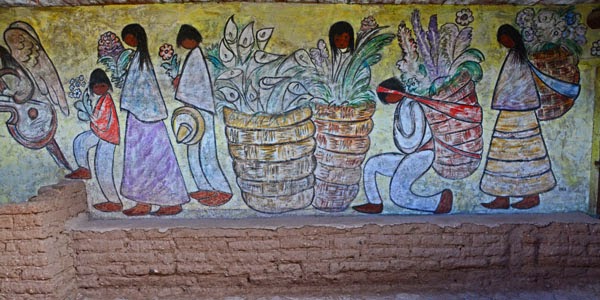
The entire right wall is devoted to a large group of Indian people bringing baskets of flowers to the chapel.   The center length of the chapel has an open roof.


A blue painted tablet tells the story of Juan Diego and the first appearance of Our Lady of Guadalupe near Mexico City in 1531.


People come from all over just to visit the Chapel and its exquisite architecture and beautifully painted decoration!  


Moving along to the large adobe gallery building, entry is by heavy metal double doors framed to appear like the entrance to a mine.  DeGrazia was born in 1909 in Morenci, Arizona, a copper mining town and his father worked in the mine, so the artist's early days are reflected in this entrance.  

Just inside on the left is a room with musical instruments as again, DeGrazia was also a musician and appreciated the connection between art, color and music.  His Gallery in the Sun was opened to the public in 1965.   DeGrazia always said that he built the Gallery in the Sun so that his paintings “would feel good inside!”  Isn't that a unique perspective?

"Horseback" (Padre Kino)

DeGrazia loved the color and movement of bullfights
The Gallery in the Sun is constructed so you walk through a series of gallery rooms, containing six permanent collections, each in its own room and several rotating exhibits.  Each collection is dedicated to one of DeGrazia's most prolific interests and painting subjects.  Most rooms also hold a showcase or other display of many of DeGrazia's personal collection of artifacts, especially minerals.  Here are the subjects of the Permanent Collection gallery spaces in order of display:  Padre Kino, Cabeza de Vaca, Papago Indians, Retrospective, Yaqui Easter and Bullfight.   We show a few of our favorites here.


On the right a self portrait of the early '80's
Near the end of the Gallery rooms, there is a door to the outside garden, which is well worth walking through.  The garden is a courtyard surrounded by the Gallery buildings and offices.  It is very beautifully landscaped and expertly maintained with many cactuses, succulents, trees and native plants, some flowering. There are many found objects of DeGrazia, including a French horn, heads of shovels, glass objects and much more.  A nearly lifesize Yaqui deer dancer is the centerpiece of a pond, with many koi swimming around


There is a side room off one of the last galleries with a large television playing movies of DeGrazia discussing his beginnings, the Gallery in the Sun, the desert landscape, his love of the Missions and Padre Kino,  and his close attachment to the local Tohono O'odham, Yaqui, Seri and other Indian peoples. In this room, there are large photographs of DeGrazia working on various art projects mounted on his painting easels. Each time we visit, we feel that he is telling us personal stories about his own life and why he paints certain subjects.  We did meet him once in the late 1970s and acquired one of his ceramics.  We feel a personal connection with him, unlike any other artist. 

Before Ted DeGrazia passed away in 1982 at age 73, he formed the DeGrazia Foundation to hold his collection of 15,000 DeGrazia originals, to maintain the Gallery in the Sun property in perpetuity and to continue his policy of free admission to the grounds.  The Gallery in the Sun complex was added to the National Register of Historic Places in Fall 2006.   Amazingly, photography is allowed in the Gallery with the use of flash prohibited.  That is how we are able to show you on this blog post a number of DeGrazia paintings that we particularly love!
We returned to the Gallery in the Sun a second time on the day we left Tucson to start home as we wanted to see the Chapel again and discovered that we missed more painted art.  We saw more birds, probably doves or swallows, as well as a roadrunner.  We also saw a clown on the wall—context unknown, an angel playing violin, Christ on the cross, children with balloons, an Indian playing a violin and another playing a flute and drum and finally, a group of Indians watching a cock fight!

We also knew that Ted was buried on the property and wanted to see his grave, and that of his wife Miriam, who died in 2002.


Under the tree on Miriam's grave are lots of angels---the stone pyramid is Ted's Eternal Christmas Tree
Finally, after looking at the Gallery's catalog of prints, we wanted to buy San Xavier Mission Fiesta and Children Dancing around a Saguaro to add to our home art collection.  Needless to say, these are good reproduction prints, not originals!  Even small originals can cost $5000 and much more!  Just wished I'd bought a few originals in the 80s!!
To us, DeGrazia is the quintessential Southwest artist!  Now, 32 years after DeGrazia's death, streams of visitors come 7 days a week to get acquainted with the man through his art and architecture.  Most, like us, leave amazed and delighted!  This year, 2015, is the 50th Anniversary of the Gallery in the Sun complex!  When in Tucson, be sure to stop by and have your own DeGrazia experience!


Thursday, March 5, 2015

USA--Tumacácori NHP, ASARCO Mission Mine Tour, Mission San Xavier del Bac


We left Nogales at 12:35 PM on Wednesday, 3/4/15 and drove north on I-19 about 16 miles to Tumacácori National Historic Park, (Tomb-a-cock-or-ee) which preserves an old Spanish mission church, San Cayetano de Tumacácori, founded in 1691 by Padre Eusebio Francisco Kino, known as the “Padre on Horseback.”  The original mission location was moved from the east banks of the Santa Cruz River to the west bank of the river in 1751 after devastating Indian attacks and the name was changed to San José de Tumacácori.   The Presidio of Tubac was established in 1752, about 10 miles north, with 50 Spanish soldiers to protect the area from Indian raids.

Tumacácori never had a resident priest since it was a visita of Mission San Gabriel de Guevavi, 12 miles away.  A small adobe Jesuit church was erected at Tumacácor in 1757 on a nearby site and survived for 65 years.  International politics were about to raise its ugly head when in 1767 the Spanish King expelled the Jesuits from all Spanish territories and replaced them with the Franciscan order.  In 1771, Tumacácori became mission headquarters and gained a resident priest for the first time.  The church property was walled-in, adobe dwellings were built for the Indians and the church was refurbished with new decoration in and out. In 1787, Guevavi and another visita, Calabasas, were abandoned due to Indian attacks and dispersal of its Indian converts. 

About 1800 Fray Narciso Gutierrez, a Franciscan, began construction of the present larger church, built and decorated like the larger church of San Xavier del Bac close to Tucson.  In the next years, funds ran out and construction stopped but Indian attacks continued, and in 1801, an Apache attack wiped out most of Tumacácori's livestock.  The Mexican War of Independence from Spain was won in 1821 and church construction resumed, but Spain cut off all funds and work stopped again.  Final phases of construction resumed in 1823, but in 1828, Mexico deported all Spanish-born residents leaving only Mexican priests, who were already scarce.  Tumacácori once again was a visita, with no resident priest!

Next political crisis was in 1848 during the Mexican-American War plus stepped up Apache attacks and a very hard winter caused the Tubac Presidio and Tumacácori to be abandoned 157 years after Padre Kino founded the Mission.  In 1853, the Gadsden Purchase put Tumacácori inside the United States border.  In 1908 Tumacácori National Monument was created by Congress to preserve this historic site including the legacy of Padre Kino!   In 1990 Congress added the closely related, but unfortunately very deteriorated, sites of Guevavi and Calabasas to create Tumacácori National Historic Park.  The remains of the Tubac Presidio are protected as Tubac Presidio State Historic Park by the State of Arizona.  We were fortunate to take an excellent free guided tour of the Tumacácori church, outbuildings and the newly restored orchard!  Visiting takes you back through almost 325 years of Spanish borderlands history!

A little bit of the colorful murals is still visible
In the Museum was a small diorama how the church looked in the 18th century

Tubac today has turned into art colony of sorts with many shops, cafes and of course, the state park.
We spent a pleasant night at the Mountain View RV Ranch in Amado, a few miles north of Tubac.


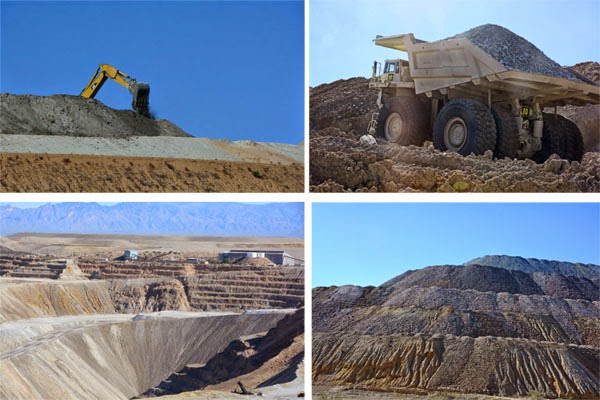
The goal was to get an early start the next morning so we could be on the 9AM first tour of the day at the ASARCO Mineral Discovery Center in Sahuarita.  The tour of the ASARCO Mission Mine, one of the largest open pit copper mines in Arizona, was excellent with a terrific guide!  It started with a bus ride up to a high overlook of the gigantic open pit copper mine, where we could watch the drills, shovels loading the huge haul trucks that bring the ore to the mill in 320 ton truck loads!!
After 15 minutes at the pit, the bus took us to the mill where we could see the crushers, ball mills and wet grinding mills that grind up the raw ore that's only 0.4% copper and concentrate it by flotation to a powder consistency that is 25-30% copper!  The two huge mill facilities here process a total of about 54,000 tons a day!
Left bottom: flotation process--mixed with pine oill bubbles seem to light up
This concentrate is trucked to ASARCO's Hayden refinery where it becomes large 99.9% copper anodes!  65% of all the copper produced in the United States comes from Arizona.   In addition to copper, this mine also produces enough gold and silver to pay its huge electric bill!  This Mission mine began operations in 1961 and is named after nearby Mission San Xavier del Bac, the most famous and best preserved of all the Kino missions.  The Mission mine facility provides the only public mine tours in Arizona and sees about 20,000 visitors per year.
At the entrance to the parking lot we saw this huge cristate saguaro cactus.

Mission San Xavier del Bac

 After leaving the mine, we drove north about 9 miles to Mission San Xavier del Bac, near Tucson.  This mission was founded by Padre Eusebio Francisco Kino in 1692 at the large Pima Indian village of Bac, now called Wa:k. As usual, it started with a small adobe chapel but since a resident priest was not available, it was only visited occasionally.  The foundations for a larger church were laid by Padre Kino in 1700, but lay vacant for a decade because of the death and sickness of assigned padres and perhaps was never finished. It's a sad fact that almost all of the original churches that Padre Kino personally planned and built were gone in 25 years or less, due to Indian raids and natural disasters such as earthquakes and floods.  In 1751, the Pima Revolt resulted in the burning and pillaging of the church.  Another adobe church was built in 1756, and its foundations are still visible 40 yards to the west of the present church.  After the Jesuits padres were exiled and the Spanish Franciscans took charge in 1768, San Xavier became the headquarters for Fray Francisco Garces and later Fray Juan Bautista Velderrain. 
In 1783 Padre Velderrain began building the current Church with money borrowed from a Sonoran rancher, and construction was completed in 1797.  The architect was Ignacio Gaona, who also designed the Church at Caborca, Sonora.  The workers were a large group of the O'odham or Pima Indians.  The Church was built with fired adobe in the form of a cross with the interior over eighty feet high! With Mexican Independence in 1821, San Xavier became Mexican, not Spanish. The last resident Franciscan left in 1837.  With the Gadsden Purchase of 1854, San Xavier became a part of the United States!  In 1859, the Diocese of Santa Fe, New Mexico took charge and began repairs to the Mission.  In 1866, the Diocese of Tucson was formed and San Xavier became part of the new diocese.  Regular Mass began again.  The Mission School opened in 1872 with the Sisters of St. Joseph of Carondelet teaching. From 1940 to the present, the Franciscan Sisters of Christian Charity teach at the K-8 school and reside in the Convent.   A violent earthquake in 1877 damaged walls and structures of the Mission. The Franciscan friars returned to San Xavier in 1913.
In 1905, Tucson Bishop Granjon took a personal interest and began major repairs to stabilize all the structures of San Xavier.  Then in 1939, lightning struck the west tower of the church requiring more repair.  More recently, in 1953 the Mission facade was restored and then in 1963, San Xavier was designated a National Historic Landmark. 

An organization that we personally support, Patronato San Xavier, was formed in 1967 to preserve the structures of San Xavier, both interior and exterior. Patronato funded an extensive 5 year interior restoration and conservation project that brought highly skilled international conservators to the Mission to restore the interior paintings, the retablo, saints and angels and the interior decorative painting on the walls.  A masterful restoration was accomplished to international acclaim. The next project starting very soon will be the restoration of the east tower of the Church.  
Today, Mission San Xavier del Bac is considered the finest example of Spanish Colonial architecture in the United States.  

The interior is absolutely glorious with gold and silver leaf, wonderful warm colors, and over 50 saints in niches around the church.  A reclining San Francisco Xavier figure in the west transept draws many pilgrims to the Mission and many prayers for relief from diseases and accidents have been acknowledged. 
The east transept contains a beautiful shrine to Mary, mother of Jesus and the patron saint of Mexico, Our Lady of Guadalupe.  Hundreds of angels are everywhere in the Church.  The altar is a masterpiece of Mexican baroque and Churrigueresque design. It is thought that most artwork in the Mission was created in the church workshops of Querétaro, Mexico and brought to the Mission on the backs of donkeys! 
There is an excellent Mission Museum, a 20 minute history video and a very complete gift shop which even sells O'odham baskets and other crafts. San Xavier is still a working Catholic parish church with daily Masses and other services for its O'odham parishioners. 
  
Each year, over 200,000 visitors drive nine miles from Downtown Tucson to the Tohono O'odham Reservation to visit Mission San Xavier del Bac!   The Mission is an inspiring place to visit and to study the amazingly beautiful craftsmanship lavished on this Church, which is still being carefully preserved for the future! 
*all timeline facts from the official San Xavier website

Wednesday, March 4, 2015

San Carlos, Magdalena de Kino, Sonora & back to the USA


We left off in Yávaros, the best birding spot we've found in Sonora!  We drove north on a good back road taking us to Ciudad Obregón, the major town for the huge agricultural valleys in this area.  We stopped for fuel and saw again that diesel in Mexico is expensive: 14.2 pesos per liter, about $3.85 US per gallon!  For many years, Mexican fuel was considerably less than the US prices, but no more, especially with the very low crude prices at this time in the US!  It took a total of 5-1/2 hours to get back to San Carlos, a run of 173 miles.  We checked in again at Totonaka RV Park for 3 nights. We needed some R&R time to clean up the rig and ourselves, do some sightseeing, some grocery shopping and get the rig washed and waxed before heading back to the US.  


Grocery shopping is easy in San Carlos with a Ley Express supermercado, smaller than the big Ley stores in large towns, but very adequate for our purposes and about a mile from the campground.  We also needed to refill one of our three 1 gallon drinking water bottles so went to the Royal Purified Water store and spent 3 whole pesos (exchange now 15 pesos to one US$) or about 20 cents US. Almost no one in Mexico drinks the tap water, so there are reverse osmosis water shops in virtually every village to supply this need.  Most people get 5 gallon bottles but we can't store that in our RV so we use 1 gallon bottles.  There is also a hefty deposit of about 150 pesos on the 5 gallon bottles unless you trade in your old one so we avoid that too.  The other need was Mexican ice cream, which is far creamier than US and is usually quite inexpensive so we stopped at the Thrifty ice cream store and had 2 cones.  The chocolate is more chocolate-ly and the fruit flavors like strawberry are more flavorful!

Next came the search for a car wash place.  Strangely in San Carlos, there are 2 hand car washes, next to each other, only separated by a taco stand!  We went to the bigger, busier one and in a hour, we were washed and waxed, no machines, all hand done and beautiful for the equivalent of $35 US.  We drove around town one afternoon and were amazed by the amount of beachside condos here since our last visit.  San Carlos has always been dominated by gringos and even more so now!  But the economy here is still shaky and like most parts of Mexico, tourism is way down!  

We went out to the high El Mirador viewpoint overlooking the whole coast of San Carlos and Guaymas and enjoyed watching the Mexican families and children.  Lots of curio stands but we resisted!   

Way down below, some people expressing love and above at the Mirador a family picture
Drove back to the big marina and walked around looking at the boats.  Then the next quest was to find some good Mexican beer!  It's appalling how Bud Light and even Coors Light have taken over in Mexico pushing out the great Mexican beers with promotional $ and big displays in the supermercados and even smaller stores and beer depósitos.  We found a depósito that admitted to having regular (NOT light) Pacífico and we bought 12 cans for the same price as Bud Light! 

Lots of gringo bucks!
Monday was Maryke's birthday so we walked up the street looking for a restaurant to properly celebrate the occasion and found a seaside seafood restaurant about 2 blocks away called Charlie's Rock, because it sits on a huge flat rock about ½ block long with a palm leaf roof and sides open to the water.  We could watch the gulls fly close by looking for a handout and best of all, watch the sunset!  The food was absolutely delicious with Lin's shrimp and Maryke's dorado fish dish, good service and they had our favorite beer, Negra Modelo!! What more could you ask for???  

Restaurant Charlie's Rock and view with Guaymas in the distance
So on Tuesday 3/3, we started north.  It had rained again at night creating a few dusty runs on our fresh wax job—darn it!  We arrived in Hermosillo at 12:15 PM and did some more grocery shopping at the big  Ley supermercado, specifically stocked up on orejas and Mexican sugar cookies. 

Off again for Rancho Betania, the place where our Chapter 8 Rally camped almost a month before.  We arrived there  at 4PM and paid 150 pesos for a full hookup site and retrieved our friend's reading glasses from the camp leader, Salvador.  Another van camper followed us in and later when talking to them, we discovered they were from Halifax, Nova Scotia and we had a good talk about how much we enjoyed Halifax when we went to the Canadian Maritimes 5 years ago and when we told him we were going to Newfoundland this Spring, he told us his favorite places.  Great coincidence! We had an extremely quiet night and a good rest.  It rained again overnight so more dust on the wax on the way out of camp!

Next morning, we drove about 40 minutes north to the town of Magdalena de Kino, famous as the burial site of Padre Eusebio Francisco Kino, the famed Jesuit missionary who founded a chain of missions in Northern Sonora, Mexico and Southern Arizona, beginning in 1687. Kino's grave was finally found and overwhelmingly verified in May 1966 by a expert team of anthropologists and historians after many years of elusive search around the town of Magdalena, beginning as early as 1919.  Kino died in 1711 and was buried by Padre Campos in the chapel of San Francisco Xavier here in Magdalena as he carefully recorded.  The problem was where was the chapel in 1711 and where was the town itself in 1711?  Eventually, a historian found an obscure account from 1828 describing the chapel and its location at that time and mention of the two lay persons buried there. The location of the present day church of Santa Maria Magdalena completed in 1822 was found to be a very long block away from the location of the original church begun in 1705 with the 1711 chapel of San Francisco Xavier separated by several hundred yards.  When these structures fell, the town Palacio Municipal or City Hall was constructed over the sites and was in use until 1966 when Kino's grave was discovered and the city offices were then moved 3 blocks away to a school which had formerly been the Palacio Municipal!   Over 2 KM of trenches were dug all over the central area of town where the former and current churches and chapels were located before the grave site was finally found with all five burials exactly in the proper location and relationship to each other as reported 255 years earlier by a very precise Padre!   Extensive forensic research was then done to positively confirm the identities and finally conclude the search for Padre Kino!
Statue of Father Kino--- detail on Church facade----inside look towards main altar

Some of the statues were dressed in real robes for Lent ---- Monstrance with remnant of bone from St. Francis

Prominent Magdalena citizens, Sonora State and Mexican Federal officials and the INAH federal anthropological agency formulated a complex plan to fund and build the remarkable Padre Kino Memorial Plaza that exists today.  

The Plaza takes up about 3 square blocks surrounding the church, which was also restored, the San Francisco Xavier chapel, a monumental crypt for Kino's burial site with murals of his life, a statue of Padre Kino, a large U-shaped Spanish style arcade with a Kino Museum and Library, religious article sales and other shops and restaurants. The town name was changed to Magdalena del Kino to celebrate the great discovery! The President of Mexico, Luis Echeverria Alvarez, who had taken a personal interest in this project, came to Magdalena and dedicated the completed Plaza on May 3, 1971.  Magdalena is now also a Pueblo Mágico, the second one in Sonora.

The Kino crypt has 4 windows to view downwards about 10 feet to view the skeleton of Padre Kino, who was buried along with two Padres from Mission Tubatama and 2 lay persons.  Along with the murals painted on the ceiling of the crypt, it is very impressive. 

The church is in very good shape and the adjacent San Francisco Xavier chapel is quite plain with a life-size figure of the Saint clothed in Franciscan garb lying on a sepulchre in the center. The faithful stand in long lines to touch this figure and some lift up the head and kiss it, in their devotion.  A relic of an arm bone is displayed nearby in a gold monstrance.  We found the story of the long path to the discovery of Kino's grave very interesting.


We left Magdalena de Kino later that morning and drove 58 miles to the US border and found only six vehicles ahead in our line—unheard of to have such a short line!!  A very pleasant female agent asked the usual questions, came inside to look around, announced that our RV was “awesome” and passed us without the usual detour to the dreaded “secondary” inspection.  We celebrated our speedy border passage a few minutes later with an all American cheeseburger at McDonald's in Nogales, Arizona!!  We were back in the good old US of A!!      More on Padre Kino coming in the next exciting post!