Friday, April 24, 2015

BLOG 7 -- RURAL PENNSYLVANIA -- The Amish in Lancaster County


When we left Gettysburg, PA we headed for Lancaster and some of the Amish towns that we enjoyed visiting in the past.  We needed to be close to Reading later that afternoon so it was a quick trip. 


We stopped first at Intercourse and went through some of the shops, in particular, the Stoltzfus Meat Market that has a wide selection of bulk and fresh foods and lots of samples of meats, cheeses, peanut butter and many different fruit jellies.  We found something new to us—chocolate peanut butter and bought a ¼ lb.tub—it's delicious!  We also sampled a bunch of different cheeses and especially liked their Swiss and Rye cheese and bought a piece that we're really enjoying!


Across the street, the Intercourse Cannery store had many other very tasty samples of their foods, but nothing that we really wanted, especially with our very small refrigerator space.  


We saw a few more Amish buggies come down the street along with a much larger buggy for a commercial tour company—an excursion buggy!  


One store had a display of custom made copper roof cupolas that were very ornate with a shiny copper finish!  Amazing that the town of Intercourse was founded in 1754!


Very creative windows of one store--the paintings look so real!
 We also visited Blue Ball but nothing there attracted our attention and the traffic was very heavy.  Next was the town of New Holland which we had never stopped at before.  

The New Holland agricultural machinery company has its headquarters here and a large display of equipment in front.  

We saw a new-to-us type of Amish buggy that looked a bit like an old pickup truck since it had a pickup-type bed behind the covered cab; probably very useful for trips to the feed store or hardware store!

We turned into a country road and finally found some Amish and Mennonite farms.  We were excited to find several horse drawn plows working in the fields and stopped on the side of the road for a while to photograph them. 

Several had 4 horse teams and the last one had an amazing 8 horse team!  Never seen that many horses on one plow before!  It was fascinating to see them make a turn with all the horses moving in unison!   

We drove along slowly enjoying the clean, well kept farms and beautiful old barns, silos and dairy farms too.  It was laundry day on many of the farms obviously from the long clotheslines of clothing. 

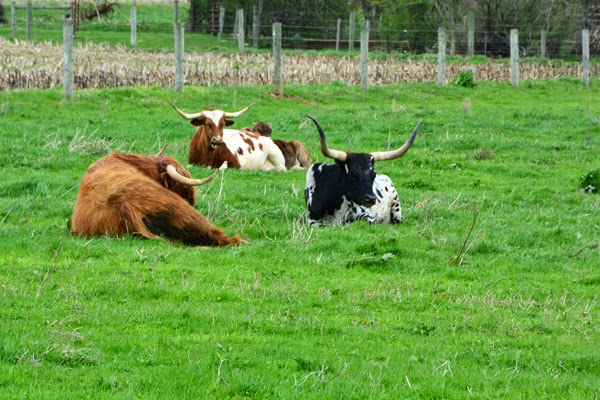
On one farm we saw a large pen with 4 Texas longhorn cattle—that was a surprise!   


Another farm had a series of igloo-type fiberglass structures that were individual calf houses!  They were all up a hill and I finally found one house with the calf's head in view!  The others were on nap!  Some of the farms had big tall open mesh bins of corn which we figured must be animal feed???

A couple of the barns we saw looked like something out of a beautiful painting with several cupolas on top of the roof.  Some farms kept their old wooden barns painted and in good repair and other farms let them go and some were falling over from disuse.   

The highlight of the day had to be the horse teams plowing the fields!  It was just magical watching them pull together so precisely and knowing just when to turn at the end of a row!

It's always pleasant to visit the Amish country, see the quilt stores, all the delicious foods and cheeses and much more.  What we missed were the “Cheeser” pretzels that we bought last year in several places in Indiana and even Virginia and really enjoyed.  But many other nice country sights made it a very pleasant drive that we'll look forward to doing again in the future!
Typical Amish Folk Art painting we saw in a store
These gorgeous trees were in bloom all over the place
That evening, we had a very nice visit plus dinner with our son and his family.  Our grandkids are now 5 and 8 and really growing up fast.  It was sure good to spend a little time and get reacquainted!  
Megan, Rick and Lin

Wednesday, April 22, 2015

BLOG 6 -- EISENHOWER NATIONAL HISTORIC SITE + LINCOLN TRAIN MUSEUM


As Supreme Allied Commander, 5 Star General Dwight D. Eisenhower planned and executed Operation Overlord (D-Day) leading to the eventual surrender of Nazi Germany and lasting peace in Europe. After World War II, he became President of Columbia University in 1948 for 2 years. The General assumed command of NATO forces in Europe in 1950. 1952, the very popular General was elected President of the United States and successfully guided the country through 8 years of the Cold War without further conflict. In 1950, Ike, as he was called, and his wife Mamie, bought an large old farm near Gettysburg as their retirement home and began renovations. The farm was used as their weekend retreat and Ike's temporary White House as he recovered from a heart attack in 1955.  Retirement finally came in January 1961 as Ike finished his second Presidential term and JFK was inaugurated as President.  Ike and Mamie had 2 sons with the first dying at 3 from scarlet fever.  Son  John Eisenhower went on to West Point graduating on D-Day 1944 and rose to Brigadier General and later U.S. Ambassador to Belgium.  He had 4 children giving Ike and Mamie 4 grandchildren!

Oil paintings of both Mamie and Ike hanging in the living room.
The 5-star General flag waves on the flagpole
Dwight Eisenhower was born in Dennison, Texas in 1890 as the 3rd of 7 sons. The family moved to Abilene, Kansas in 1891 and Ike graduated from high school there. In 1911 he was appointed to West Point and graduated in 1915. He met Mamie while serving at Fort Sam Houston and they married in 1916. Ike truly had an illustrious Army career and quickly moved up in rank and served in a number of high posts, including the American Battle Monuments Commission under General Pershing. 1933-39 he served as General MacArthur's chief military aide including travel to the Philippine Islands.  In 1939 he served as Chief of Staff, 3rd Army. He was promoted to Brigadier General in October 1941 then after Pearl Harbor, moved to Washington, D.C. working on high level war planning at the War Department.  Ike was appointed Commander of European Theater of Operations in 1942 and commanded the Allied invasion of North Africa.  Continuing to move up, Ike commanded the invasion of Italy and was Supreme Commander, Allied Expeditionary Forces, Europe.  After the very successful Normandy invasion, Ike was promoted to 5 star General of the Army in December 1944.  He accepted Germany's unconditional surrender and became Commander of the U.S. Occupation Zone in Germany.  Later in 1945 he became the U.S. Army Chief of Staff, the top Army post.  Ike retired from active Army service in 1948 and became President of Columbia University.

Mamie's guestbook showing signatures of their son and granddaughters
In Fall 1952 General Eisenhower was elected 34th President of the United States on the Republican ticket and re-elected again in 1956, both won by a landslide vote!  During his 8 years as President, Ike's biggest accomplishment was preserving the peace!  He also established the Dept. of Health, Education and Welfare (HEW), helped to engineer the 1953 Korean War armistice, approved the spy satellite program, raised the Federal minimum wage to $1 per hour, championed the construction of the Interstate Highway System, signed the Civil Rights Act, established NASA starting the “Space Race” with Russia, welcomed in Alaska and Hawaii as the 49th and 50th states, launched DARPA which led to the Internet, encouraged the peaceful use of atomic energy and met with Soviet Premier Khrushchev at Camp David and Ike's Gettysburg farm. Shortly after that visit in 1960, the U2 crisis occurred when a U2 spy plane was shot down by the Russians and the pilot captured.   The Gettysburg farm was not only Ike's retreat from the pressures of Washington but also his personal venue for diplomacy and informal talks with world leaders.  His 1961 Farewell Address to the Nation in part warned to guard against the unwarranted influence of the “military-industrial complex” and the increased spending of huge amounts on defense at the cost of other national priorities.

The Grand piano, Ike's library, the 50's TV set and the formal living room
After retirement, Ike kept busy with a successful Black Angus cattle raising and breeding operation for 15 years on 189 acres of his farm and an adjoining 306 acre farm owned by partners.  His cattle won Grand Champion ribbons at many major competitions.  He maintained an office at Gettysburg College and wrote his memoirs, including his famous book, Crusade in Europe.  He enjoyed painting, having painted over 260 oils in his last 20 years, and a number of his paintings hang on the walls of the home.  Ike was also fond of cooking both indoors and on the outside barbeque.  And, maybe it comes with the Abilene, Kansas heritage, he loved to read Western novels, especially Zane Grey, and had a large collection of them, which are still in the house!  Ike also was fond of reading, fly fishing, golf and playing bridge.  Eisenhower is considered one of greatest ten U.S. Presidents!


 A visit to the Eisenhower Farm is by shuttle bus from the main Gettysburg NMP Visitor Center ($7.50 each) unloading near the barn closest to the house.  An interpreter tells about Ike's life on the farm and leads you to the house tour.  Another interpreter meets you at the front door, shows Mamie's guest book in the entrance hall and guides you to the large formal living room.  The home still has almost all of its original furnishings, offering a very special view into the later life of this famous couple!  There are many things to see in the living room—the grand piano topped with family photographs at one end and the marble fireplace at the other end that was removed from the White House by President U.S. Grant in 1873 and found and gifted to Eisenhower by his White House staff as an anniversary gift. Over the fireplace mantel, an oil painting of Prague was given to General Eisenhower by its citizens at the end of World War II, in appreciation for the Allies not bombing Prague into oblivion. 

One of Ike's paintings, the "modern" kitchen, the study and the master bedroom
A beautiful coffee table was a gift from the Republic of Korea and a silk rug came from the Shah of Iran.  A large knickknack cabinet contains many other gifts from heads of state given to the President.  On the top shelf, a triptych painting represents the appreciation of Belgium for the return by the Monuments Men after WWII of the priceless Ghent altarpiece painted by Jan Van Eyck.  There are oil paintings of both Mamie and Ike hanging in the living room.  We were told that Ike did not like the living room as it was “too stuffy!”  

The cabinet full of knickknacks and gifts. A copy of the Ghent Altar piece in miniature is on the top shelf
The Eisenhower's favorite room was the large covered porch.  They entertained here, watched television, played cards, played with their grandkids and Ike painted here.   Their large 1950s kitchen was reportedly featured in a home magazine as the “kitchen of the future.”  Ike liked to cook and his repertoire included soups, stews and Pennsylvania Dutch breakfasts.  The Eisenhowers had a cook that prepared most meals as Mamie wasn't at her best in the kitchen.  She joked that she could make fudge and mayonnaise! Both Ike and Mamie preferred basic American food.

The house has 8 bedrooms, nine bathrooms, formal dining room, kitchen and butler's pantry and the glassed-in porch.   Upstairs, we saw the various bedrooms including the master bedroom and the guest rooms.  The den and Ike's office are interesting because of so many personal items still visible, just as they were left.

Magnolia trees in full bloom
Outside, the trees were in bloom and the tall flagpole was impressive with the 5 star General's flag flying proudly beneath the Stars and Stripes!  There are 2 greenhouses that were used for both flowers and vegetables.  Ike's putting green, given to him by the Professional Golfers Assn.in the 50s, complete with sand trap, is again impressive for the 5 star flag marking the hole!  There is a small gift shop along with exhibits of Ike's Army career and a short film.  Time flew and we didn't get to walk out to the cattle barns and other outbuildings.  We felt privileged to get this view into Ike and Mamie's private life.

The Eisenhowers gifted their farm to the Federal Government in 1967, with a proviso that Ike and Mamie could live there for the rest of their lives.  The farm acreage is adjacent to and part of the historic Gettysburg battlefield and by Act of Congress, it became the Eisenhower National Historic Site in 1967.  Ike died March 28, 1969 at 78 years of age and was buried in his hometown of Abilene, Kansas with full military honors.  Mamie lived at the Gettysburg farm for another 10 years before passing away on November 1, 1979 at age 82.  She was buried next to Ike at the Eisenhower Presidential Library in Abilene.  


While we were in Gettysburg, we visited the Lincoln Train Museum downtown.  The major focus is Lincoln's funeral train but using a clever technique Lincoln comes to life as character actor Jim Getty  takes you through some of the important events in U.S. history. Later you sit in a replica of the funeral train and learn of the stops in major cities and the great public sadness on Lincoln's death by the assassin John Wilkes Booth.  There is also a museum here and several very large and detailed model train layouts.  We enjoyed our visit and Gettysburg very much!  

Walking through a gallery with several TV screens a Lincoln impersonator gave a history lesson starting at the Revolutionary War and ending with 9/11. 


BLOG 5 -- GETTYSBURG NATIONAL MILITARY PARK


THE BATTLE OF GETTYSBURG--
On July 1, 2, 3 of 1863, over 165,600 men of the massive armies of the North and the South came together at Gettysburg, Pennsylvania for the climactic battle of the Civil War!  Note the impressive painting of the battle action at Railroad Cut by artist Dale Gallon.  
The Union side had 93,921 men on the field while the South had 71,699 men.  General George G. Meade was in command of the Union forces with General Robert E. Lee commanding the Confederate forces. Gettysburg is infamous for the largest number of casualties in the Civil War.   Casualties, meaning killed, wounded, captured or missing, were over 51,000 including 7863 men killed in action—a truly ghastly number for a 3 day battle! *  23,000 casualties on the Union side and 28,000 on the Confederate side!  In addition at the end of the battle, the small town of Gettysburg was nearly in ruin with wounded and dying men from both sides being tended in virtually all the buildings and homes of the town. Many dead still lay on the battlefield with farmers and townspeople burying as many as they could. Over 3000 horses were killed in the battle and later were burned, with the great stench causing sickness to the townspeople.

Gettysburg train station where Lincoln arrived
4-1/2 months after the battle on November 19, 1863 President Abraham Lincoln took the train to Gettysburg to give a “few appropriate remarks” at the dedication of the Soldiers' National Cemetery, a 17 acre plot where 3500 Union soldiers were to be buried along with 3320 Confederate soldiers, who at the end of the Civil War 1-3/4 years later,were later moved to cemeteries in the South, primarily to Hollywood Cemetery in Richmond, VA.  The audience has been estimated at 15,000-20,000 people including a number of Gettysburg veterans. The principal speaker that day was Edward Everett, the noted orator from the state of Massachusetts, who gave a “well-received” two hour speech. It was  followed by President Lincoln's 272 word Gettysburg Address that lasted two minutes!  The President's speech was so short, Lincoln's audience was stunned and showed little reaction, leading Lincoln to think he had failed. But he had not!  Most schoolchildren learn Lincoln's Gettysburg Address while Everett's speech is virtually unknown.  Everett himself wrote to Lincoln the next day “I should be glad, if I could flatter myself, if I came as near to the central idea of the occasion, in two hours, as you did in two minutes.**  Lincoln's speech set the tone for the country to heal after the devastating Civil War.
The Gettysburg National Military Park is 5000 acres or approximately 9 square miles.  The historical battlefield was 11,500 acres so there are ongoing public and private efforts to acquire more of this sacred ground before encroaching development.  
There are 466 battle monuments and 367 tablets in the park to memorialize many of the units that fought for both the North and South. There were 631 cannon on the battlefield during the battle; a large number remain, placed along the 24 mile Auto Tour Route. Gettysburg was the 4th Civil War Battlefield to become a National Park.

The largest Battlefield memorial is the incredible Pennsylvania state memorial 110 feet tall crowned by the Goddess of Victory and Peace.  Statues of 5 Pennsylvania Union Generals including Commanding General George G. Meade line the perimeter in addition to Pennsylvania wartime Governor Andrew Curtin and President Abraham Lincoln. 90 bronze tablets list all 34,500 Pennsylvania soldiers who served during the Civil War.

Our RV in front of Vermont Memorial


Following are several images we made on the Battlefield.  Most are impressive unit memorials but there are also shots of cannon, fences, farmhouses and barns. 


The hopeful Eternal Light Peace Memorial was dedicated by President Franklin D. Roosevelt in 1938 “To Peace Eternal in a United Nation” on the battle's 75th Anniversary! 
Eternal Light Peace Memorial
Barns and Cannons

6th New York Cavalry Memorial with bronze battlefield scene


11th Pennsylvania Infantry Memorial and plaque of casualty numbers
Memorial to the Grand Army of the Republic                             11th Mississippi Infantry Regiment Memorial

Up on Seminary Ridge, the Lutheran Seminary was in session during the Gettysburg battle and many of its buildings have memorial tablets.  The Seminary's main building at that time, Schmucker Hall, was turned into a major field hospital during July through September 1863 treating over 600 Union and Confederate soldiers.  It is now the Seminary Ridge Museum of the Gettysburg battle. 


Seminary Church                                                  Schmucker Hall
 
Civil War era mansion on Seminary Campus
One of my favorite memorials is the North Carolina Memorial sculpted by Gutzon Borglum, the sculptor of Mount Rushmore National Memorial. Several tablets tell the story.  North Carolina had 125,000 men fighting for the Confederacy and 25% of them were killed during the War.

North Carolina Memorial and tablet
View of the battlefield towards town from North Carolina memorial
The Virginia Memorial honors its soldiers and the Confederacy's commanding general, General Robert E. Lee, astride his favorite horse, Traveler.  Lee watched Pickett's Charge near here
on July 3, 1863. 
Virginia to Her Sons at Gettysburg Memorial                                    Gen.Robt.E.Lee on Traveler


The Louisiana State Memorial is also moving with a dead soldier at its base and a soaring figure above symbolizing the “Spirit of the Confederacy.”


The Visitor Center Museum offers many exhibits of battlefield artifacts, an optional movie “A New Birth of Freedom” and the optional Cyclorama bringing to life with a light and sound show the 377 foot painting of Pickett's Charge.  Park Rangers conduct numerous free programs throughout the Park and you can even hire a Licensed Battlefield Guide to ride along with you through the Battlefield.

The 24 mile Auto Tour has 16 major stops but many more are possible,depending on your state origin and interests.  Lin's father's side of the family all come from North Carolina and Virginia (Confederate) while his mother's side were all from New York (Union) accounting for his interest in the Civil War.
Gettysburg is a fascinating place to visit but sad also from the brother killing brother aspect of our Civil War. The Battlefield today at sunset with its many open spaces, forests and rocky hills, farmhouses and barns is actually beautiful and peaceful, in contrast with the carnage that occurred here 152 years ago!


Our next blog will take you to Gettysburg's other national treasure, the Eisenhower National Historic Site, the farm and home of President and General Dwight D. Eisenhower and his wife Mamie. In addition, a short tour of the Lincoln Train Museum, also in Gettysburg, where President Lincoln, portrayed by skilled character actor, Jim Getty, takes you through U.S. history on Lincoln's funeral train back to Springfield, IL.


*Busey and Martin, Regimental Strengths and Losses at Gettysburg 2005
**National Park Service Gettysburg National Military Park visitor brochure